Worker and machinery tracking
Multi-object tracking across overlapping camera coverage with consistent identity through occlusion.
From incident detection to incident prevention.
A vision system that models how people, vehicles and machinery move through a shared space, scoring emerging risk from trajectories and near misses instead of waiting for an incident to detect.
01 · The problem
Safety programmes are built on incident reports, which means they learn from the events organisations most want to prevent. Near misses, which are far more frequent and equally instructive, were recorded only when somebody bothered to file one.
Existing camera systems detected a person in a restricted zone after entry. By then the useful window for intervention had closed. The client wanted to know about the convergence, not the collision.
02 · What we did
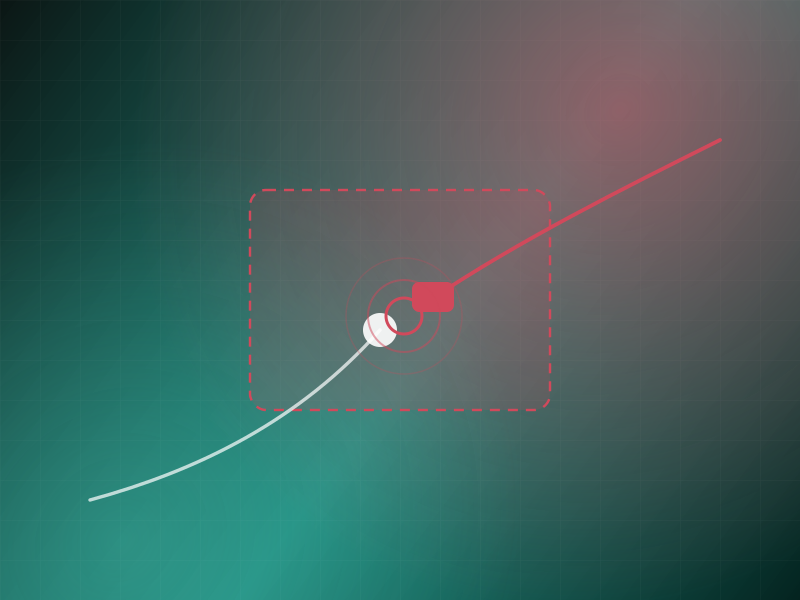
We model motion rather than presence. Workers, forklifts and machinery are tracked as trajectories, and risk is computed from projected paths, meaning where those bodies will be in three seconds given where they are heading now.
Near misses became first-class data. Every convergence that came within a defined margin is recorded automatically, giving the safety team a dense stream of leading indicators instead of a sparse trickle of lagging ones.
Waiting for an incident to learn from is the most expensive possible training set.
Two of the screens that carry the most weight in daily use, rebuilt here from the production design system.
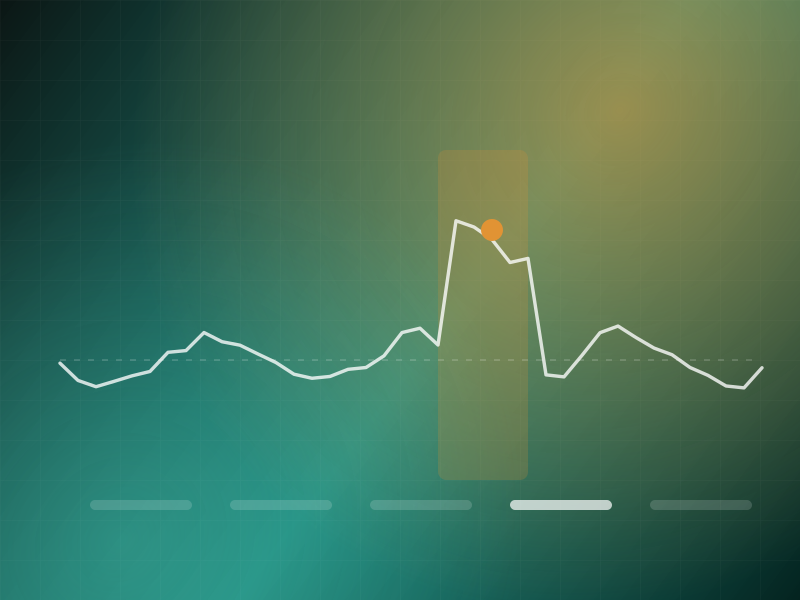
Risk rises before contactTrajectories are projected three seconds ahead, so convergence is flagged while there is still time to intervene.
Layout problems, not just behaviourNear-miss density mapped onto the floor plan separates badly arranged space from individual error.
Grouped by the job each set of capabilities exists to do, rather than by which team built it.
Multi-object tracking across overlapping camera coverage with consistent identity through occlusion.
No facial recognition and no worker identification. The model reasons about bodies and vehicles, not people.
Geofenced areas with rules that vary by time, machine state and permit status rather than being always-on.
Overlapping views fused into a single floor-plan coordinate space.
Short-horizon path projection for every tracked body, accounting for speed, heading and typical routes.
Pairwise convergence risk between people, vehicles and moving machinery.
Convergences within a defined margin logged automatically with the clip and trajectory context.
A live floor-level score that rises before contact rather than reporting after it.
Escalation from local visual warning to supervisor notification based on score and persistence.
Near-miss density mapped onto the floor plan, showing where layout rather than behaviour is the problem.
Risk patterns correlated with shift, congestion and production rate.
Whether a layout or process change actually reduced near-miss density, measured rather than assumed.
Layer by layer, with the reason each one exists, because the reason is usually the interesting part.
Detection and tracking run on site. Only anonymised trajectory data leaves the camera network.
Homography calibration mapping every camera view into a shared floor-plan coordinate system.
Short-horizon trajectory models with interaction-aware scoring across tracked pairs.
Graduated notification with local signalling, supervisor push and escalation policy.
Near-miss store with floor-plan heatmapping and intervention effectiveness tracking.
Technology
Measured against how the operation ran before, not against a benchmark chosen after the fact.
Leading indicators replaced lagging ones. The safety team works from near-miss density instead of incident counts.
Layout problems became visible. Hotspot mapping separated where the floor is badly arranged from where behaviour is at fault.
Footage never leaves the site. Inference runs at the edge and only anonymised trajectories are stored.
Interventions are measured. A change is judged by whether near-miss density actually fell.
How it ran
Mapped movement patterns and agreed the privacy position with the workforce before any camera was configured.
Tracking, multi-camera fusion and the floor-plan calibration tooling.
Trajectory models and interaction risk, tuned against historical near-miss footage.
Graduated alerting, hotspot analysis and intervention tracking.
From defect detection to defect causality.
A multimodal system that correlates line video, machine telemetry, batch records and operator actions to explain why a defect happened, not merely that it did..
Not alarm detection. Failure hypothesis reduction.
A correlation engine that turns an alarm storm into a short ranked list of probable root causes by reasoning over network topology and fault propagation rather than alarm counts..
From a single inspection to longitudinal asset integrity.
A vision system that detects and localises pipeline deterioration, then tracks each defect across inspection cycles so maintenance is prioritised by progression rather than by appearance..
Tell us what you run. We will get back to you as soon as possible with what we would build for your situation and, just as usefully, what we would leave out.