Synchronised ingestion
Camera streams, PLC and SCADA tags, MES batch events and operator terminal actions ingested with a common time base.
From defect detection to defect causality.
A multimodal system that correlates line video, machine telemetry, batch records and operator actions to explain why a defect happened, not merely that it did.
01 · The problem
The plant already had vision inspection. It reliably flagged defective units and stopped there. Every flag opened an investigation that a quality engineer ran by hand: pull the video, pull the PLC history, find the batch sheet, interview the shift.
Investigations took days and usually ended in a plausible story rather than a demonstrated cause. By the time anyone concluded that an extruder temperature excursion was responsible, four more hours of product had gone through the same excursion.
02 · What we did
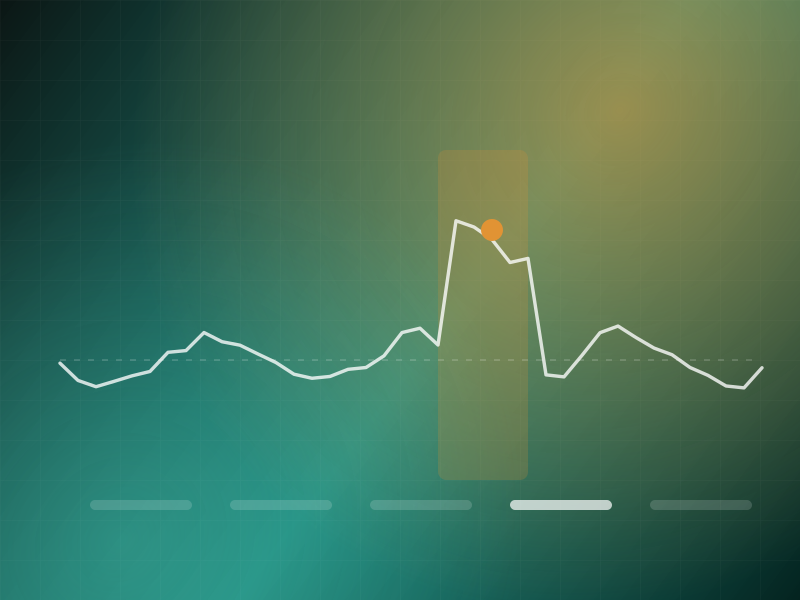
The core insight is that causality lives in time alignment. We built a temporal correlation engine that puts video frames, PLC tags, batch events and operator actions on one clock, so a defect at 14:32:07 can be walked backwards across every modality simultaneously.
Rather than a black-box classifier, the system produces ranked hypotheses with the evidence attached: the deviation window, the frames, the tag traces and the historical precedents. A quality engineer confirms or rejects a hypothesis, and that judgement feeds back into ranking.
Detection tells you a unit is bad. Causality tells you what to change.
Two of the screens that carry the most weight in daily use, rebuilt here from the production design system.
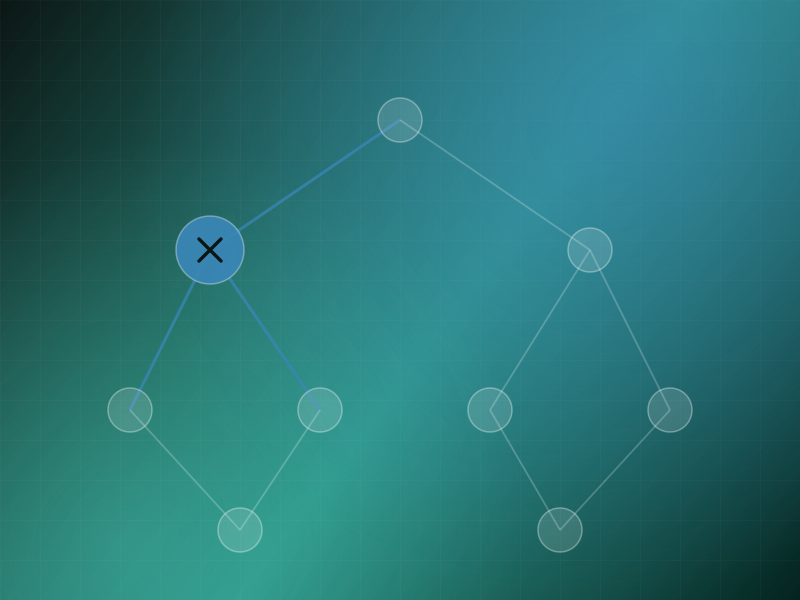
One clock, four streamsVideo, PLC tags, batch events and operator actions share a time base, so a defect can be walked backwards across all of them at once.
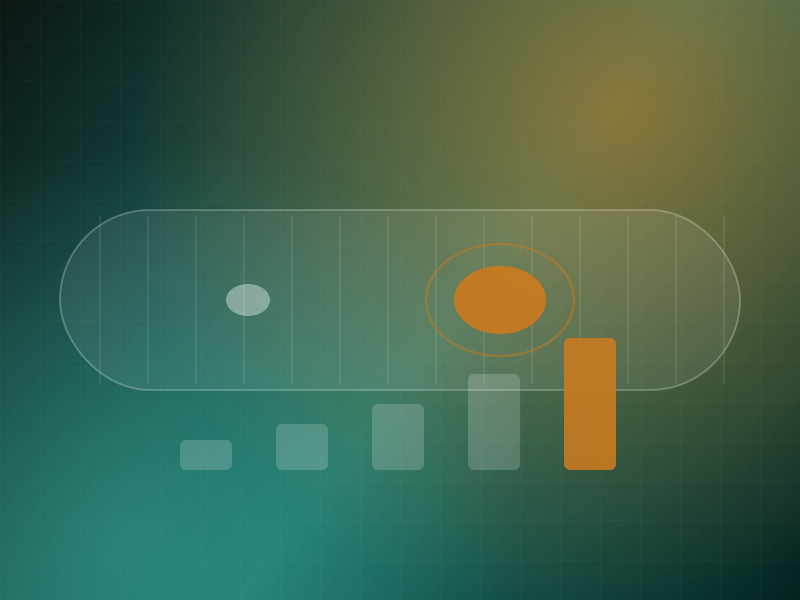
Hypotheses, not verdictsEach candidate cause opens with its frames, tag traces and historical precedents already assembled for an engineer to confirm or reject.
Grouped by the job each set of capabilities exists to do, rather than by which team built it.
Camera streams, PLC and SCADA tags, MES batch events and operator terminal actions ingested with a common time base.
Continuous alignment against a reference source, because a two-second drift destroys causal reasoning silently.
Frame selection and feature extraction at the line so bandwidth carries signal rather than raw footage.
Full-fidelity retention around flagged events and downsampled retention elsewhere.
Each defect is walked backwards across every modality within a configurable window to find coincident deviations.
Candidate causes scored on temporal proximity, historical association and deviation magnitude.
Per-asset normal envelopes learned from history, so deviation is judged against that machine rather than a spec sheet.
Defect clustering by material lot, shift, tool change and recipe version to separate systemic from incidental causes.
Every hypothesis opens with its frames, tag traces, batch context and precedents already assembled.
The reasoning path is inspectable at each step rather than delivered as a score.
Confirmed and rejected hypotheses adjust ranking for future occurrences.
Once a cause is confirmed, its signature is watched for and flagged on first recurrence.
Layer by layer, with the reason each one exists, because the reason is usually the interesting part.
Industrial gateways performing frame selection, feature extraction and buffering, resilient to plant network interruption.
A synchronisation service that normalises timestamps across sources and continuously corrects drift.
Defect detection and segmentation trained per product family, with frame-level embeddings retained for similarity search.
Windowed multi-stream analysis producing candidate causes with proximity, magnitude and historical-association scores.
Investigation workspace with synchronised video scrubbing against tag traces and batch context.
Technology
Measured against how the operation ran before, not against a benchmark chosen after the fact.
Investigations moved from days to minutes. Evidence assembly, previously the bulk of the work, is automatic.
Causes are demonstrated, not argued. Every hypothesis carries the frames and traces that support it.
The system learns from its engineers. Confirmations and rejections change how future hypotheses rank.
Recurrence is caught on the first repeat. Confirmed signatures become monitored patterns.
How it ran
Catalogued every available signal and, critically, measured the clock drift between them.
Built and validated synchronisation before any modelling, because nothing downstream works without it.
Per-family detection models and the windowed correlation engine.
Synchronised scrubbing, evidence bundles and the feedback loop.
Deployed line by line with a shadow period against manual investigation on each.
Not alarm detection. Failure hypothesis reduction.
A correlation engine that turns an alarm storm into a short ranked list of probable root causes by reasoning over network topology and fault propagation rather than alarm counts..
From a single inspection to longitudinal asset integrity.
A vision system that detects and localises pipeline deterioration, then tracks each defect across inspection cycles so maintenance is prioritised by progression rather than by appearance..
From deviation to evidence, with the audit trail intact.
A deviation investigation assistant that assembles batch records, equipment telemetry, inspection imagery, SOPs and historical deviations into an evidence-linked case file a quality unit can defend to a regulator..
Tell us what you run. We will get back to you as soon as possible with what we would build for your situation and, just as usefully, what we would leave out.